The SHOES-FIRST Capsule Wardrobe Method
Approx. 1300 words
3 mental “spoons” per hour required to read, understand, and put into practice
Written by Julie Goodie
Did you know that the average person owns close to 20 pairs of shoes, but only wears 5 of them regularly?
That’s maybe, in part, due to the fact that most people select their outfits first, their clothing first, and not their shoes. Resulting in them ending up with many outfits needing yet another, and another pair of shoes: more shopping sessions, more time spent, more money spent, more physical and mental energy spent, more physical and mental “spoons” spent searching for just the right pairs. Over and over again…
Which could so simply be averted if more people adopted the SHOES-FIRST Capsule Wardrobe Method. If they simply chose their shoes first, their accessories second, and only chose their outfits and clothing pieces last.
THE SHOES-FIRST CAPSULE WARDROBE METHOD
The SHOES-FIRST Capsule Wardrobe Method is as easy as 1, 2, 3:
You pick your SHOES FIRST;
After which, you select your ACCESSORIES SECOND (thus creating your BEAUTY BUNDLES);
Waiting until the end of the process to finally put together your OUTFITS LAST (using OUTFIT FORMULAS).
Using the SHOES-FIRST Capsule Wardrobe Method is a great way for you to reduce the number of shoes that you own saving you time, energy, and money. By limiting yourself to just a few pairs of shoes, you also end up drastically reducing the amount of decision fatigue you have to put up with each and every day, since you have less shoes to pick from on a daily basis. Plus, all your shoes end up serving a clear purpose and matching your all of your clothing pieces so that you never have to worry again about not finding a pair of shoes for each of your outfits.
On top of all that, building your wardrobe from the ground up, making sure you take the time to select shoes that are all similar in color and in style, allows you to create a more cohesive and versatile wardrobe with much less effort than if you had started with individual outfits first, or individual pieces of clothing first.
But how? How does the SHOES-FIRST Method work? If you want to try it out, I’ve created a worksheet plus step-by-step instructions below to get you on your way…
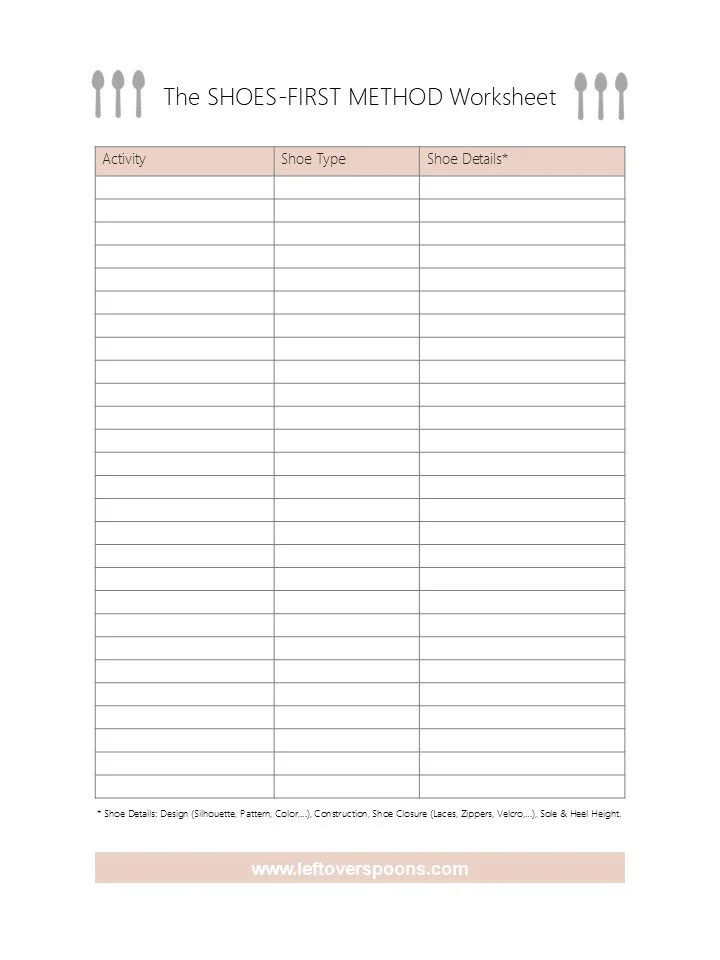
STEP 1 - MAKE A LIST OF ALL OF YOUR REGULAR ACTIVITIES
The SHOES-FIRST Method’s first step consists of making a list of all of your real-life activities: the ones you participate in on a regular basis. Do you work? If so, what type of work do you do? On your days off, how do you spend your time? Are you active? If so, do you play tennis? Do you hike? Do you play golf? Or… Do you mostly spend your days off relaxing at home? Reading? Gardening? Sunbathing by the pool?
Be specific enough in describing each activity so that it will be easy for you, later, to determine which type of shoe you will require for each activity. Also, if there are certain activities for which you think you will need different types of shoes depending the season, then use two lines for those activities: one line for the colder seasons and one line for the warmer seasons.
STEP 2 - IDENTIFY THE TYPE OF SHOE YOU REQUIRE FOR EACH ACTIVITY
The next step in the SHOES-FIRST Method is to take a closer look at your list of regular activities, and identify the type of shoe that each activity requires for optimal comfort, appropriateness and performance.
To assist you, here is a list of the most common types of shoes:
Slippers: Moccasins, Mules, Clogs, Booties, Slides, Adaptive Slippers, Novelty Slippers
Sneakers: Fashion Sneakers, Running Shoes, Canvas Sneakers, High-Tops, Hiking Sneakers, Slip-On Sneakers, Platform Sneakers, Vintage Sneakers
Sandals: Flat, Heeled (Add Type of Heel), Slingback, Gladiator, Slides, Cork Footbed Sandals (Birkenstocks), Sport Sandals, Flip-Flops, Crocs
Flats: Loafers, Oxford Shoes, Ballet Flats, Mary-Jane Flats, Pointed-Toe Flats, Mules, Moccasins, Espadrilles
Heels: Pumps, Kitten Heels, Block Heels, Wedge Heels, Stilettos, Slingbacks, Ankle Strap Heels
Booties: Chelsea Boots, Combat Boots, Moto Boots, Block Heel Booties, High Heel Booties, Western Booties, Hiking Boots, Work Boots
Boots: Cowboy Boots, Riding Boots, Knee-High Boots, Over-the-Knee Boots, Thigh-High Boots, Rain Boots
All through STEP 2, if you think the same type of shoe can be worn across a few of your activities, then do not hesitate to repeat it over and over again. As this will only help you reduce the number of pairs of shoes you end up needing day in, and day out.
STEP 3 - DESCRIBE EACH PAIR OF SHOES IN MORE DETAIL
Scavenger hunt time!!! Now’s the time to find all the pairs of shoes you own (that are maybe scattered around your house in different rooms and/or different closets). Once you’ve gathered them all, next, line them all up in the same place, in groups, by type of shoe. All athletic shoes together. All sandals together. All pumps together. You get the drift…
Then, for each type of shoe, select the pair (from what you already own) that best meets the following criteria:
Wearable (still in good condition);
Comfortable (will not hurt your feet in any way shape or form);
Appropriate (meets your desired level of formality);
Fits your personality (matches your 2 STYLE WORDS);
Versatile in color (either matches your hair color, or is in a nude color (close to the color of your skin), or is in a neutral color (ideally one that you wear in almost in every outfit)).
Once you have chosen a pair of shoes, from what you already own, for every type of shoe that you listed in STEP 2, identify which of its characteristics are most important to you. Heel height? Type of shoe closure? Type of construction or fabrication? Certain design elements? Silhouette? Pattern(s)? Color(s)?
Next, write those characteristics in the third and final column of your worksheet.
If it so happens that you don’t already own a pair of shoes that meets all of the above criteria for one or more of the shoe types that you listed in STEP 2, then maybe that explains, in part, why you’re often finding yourself with nothing to wear? Because you don’t have any good enough shoes to pair with all your outfits? If so, perhaps it’s time to go shopping? You decide, at this point, before you go any further… Before you start picking accessories to match all your shoes (before you start creating your BEAUTY BUNDLES). Before you start putting together outfits that will match your shoes and accessories (using OUTFIT FORMULAS).
HOW MANY PAIRS OF SHOES DO YOU REALLY NEED?
How many types of shoes did you list in STEP 2 not counting repeats? Five? Six? Seven? Eight? Probably not twenty.
If you listed six, for example, then you could probably make due with 6 pairs of shoes in total, or one pair of shoes for every type:
One pair of sneakers;
One pair of sandals;
One pair of flats;
One pair of everyday heels;
One pair of evening shoes;
One pair of boots.
“But, that’s so scary,” you say, “What if I get rid of all my extra shoes and end up making the wrong choices? Wasting all that money? Giving up on my goals, hopes and dreams? Forgetting all those great memories? Completely bored out of my mind?”
Who ever said you had to get rid of all your extra shoes???!!! Instead, why don’t you just put them away in storage for a while and see what happens…
I say: “Try it!!! What have you got to lose???”
In the end, the SHOES-FIRST Method can definitely help you reduce the number of decisions you have to make (or the number of mental “spoons” you have to expend) each and every day. Plus, it can also help you save time and money.
And who wouldn’t want that???!!!
